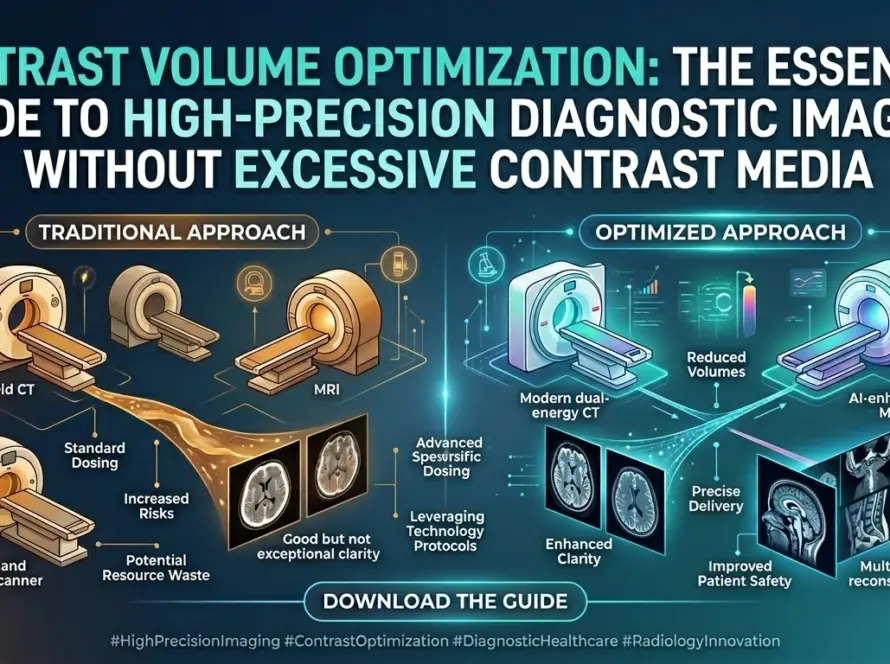
Discover how contrast media delivery systems reduce CT and MRI costs by up to 80%. This comprehensive analysis compares single-use versus multi-use consumables for high-volume radiology departments, covering regulatory compliance, technical performance, economic modeling, and environmental sustainability.
Technical and Economic Evaluation of Contrast Media Delivery Systems: A Comprehensive Analysis of Single-Use Versus Multi-Use Consumables in CT and MRI Environments
At a glance
- Multi-use contrast media delivery systems reduce iodinated contrast waste by up to 86% in centers performing 30 or more injections daily.
- Syringeless injectors decrease per-procedure setup time from approximately 199 seconds to 51 seconds, recovering over 300 technologist hours annually.
- Facilities can achieve annual savings exceeding $61,000 per CT scanner through reduced pharmaceutical and consumable expenditures.
- Plastic waste drops by up to 93% when transitioning from dual-syringe kits to single-patient-line systems.
- Dual-valve barrier technology and self-rotating luer locks prevent cross-contamination, extravasation, and venous air embolism.
- CE marking and FDA 510(k) clearance ensure global regulatory compliance for high-pressure applications up to 350 psi.
Table of contents
- Introduction
- Regulatory foundations and global compliance
- Comparative architecture: single-use versus multi-use systems
- Technical performance and safety mitigation
- Economic analysis for high-volume facilities
- Environmental sustainability and pollution control
- Clinical experience and staff satisfaction
- Strategic implementation in CT and MRI
- Conclusion
- References
Introduction
The global landscape of medical imaging is undergoing a structural transformation driven by the dual imperatives of clinical precision and operational sustainability. At the heart of this evolution lies the methodology by which contrast media is delivered during computed tomography and magnetic resonance imaging procedures. For institutions operating at high volumes—specifically those performing 30 or more contrast-enhanced injections per day per machine—the choice of consumable architecture represents a critical decision point affecting patient safety, departmental throughput, and fiscal health. Within this context, modern contrast delivery platforms have emerged as a disruptive force, offering globally compliant solutions that address the systemic inefficiencies of traditional single-use systems.1
🚀 Optimize your contrast workflow today
Discover how advanced contrast media delivery systems can transform your department’s efficiency, safety, and sustainability metrics.
Explore SATMED Health Solutions →Regulatory foundations and global compliance
The technical validity of any medical consumable is predicated on its regulatory standing. For high-pressure injection systems, safety standards are established by rigorous certification bodies. Leading contrast media delivery systems maintain both CE marking and FDA 510(k) clearance, permitting their use in all major international markets.2
Global compliance and quality assurance
FDA 510(k) clearance signifies that devices are substantially equivalent in safety and effectiveness to legally marketed predicate devices in the United States. Simultaneously, the CE mark denotes compliance with European Union Medical Device Regulations, which have become increasingly stringent regarding lifecycle management and clinical evaluation of consumables. These certifications are supported by ISO 13485:2016-accredited manufacturing facilities that ensure quality control is integrated from the design phase through to sterile packaging.3
The direct-to-factory model, acting as both an original equipment manufacturer and original design manufacturer, eliminates variability often found in multi-layered supply chains. This provides hospital administrators with a higher degree of assurance regarding the consistency of polymers and mechanical components used in daily operations.
Implications of Class II regulatory status
Injector syringes and patient lines are typically classified as Class II medical devices. This classification requires not only initial clearance but also ongoing post-market surveillance. Global approval indicates that the system has met specific biocompatibility and pressure-tolerance requirements mandated by international standards. This is particularly critical for high-pressure CT applications where consumables must withstand pressures often exceeding 300 psi without failure or leakage.4
🛡️ Ensure global compliance in your imaging suite
Equip your department with CE-marked and FDA-cleared consumables that meet the highest international safety standards.
Explore SATMED Health Solutions →Comparative architecture: single-use versus multi-use systems
The fundamental technical debate in the radiology suite centers on the fluid path. Traditional single-use systems require complete replacement of the syringe and patient tubing for every scan. Modern multi-use systems employ a delivery model that serves multiple patients over a 24-hour window.5
The mechanics of single-use syringes
Single-use systems are characterized by a manual or semi-automated workflow where a technologist loads a discrete volume of contrast and saline into individual syringes. While this model is historically the baseline for infection control, it introduces significant technical overhead. Each new patient requires opening multiple sterile packages, drawing contrast from vials, and purging air from the system. In a facility performing 30 scans per day, this repetitive task consumes roughly 100 to 150 minutes of technologist time.
The innovation of multi-use 24-hour day set technology
Multi-use day sets move away from the syringe-per-patient paradigm. Instead, a larger reservoir of contrast—typically 500 mL bulk bottles—is connected to a day set that remains valid for up to 24 hours. Only the patient-specific tubing is changed between procedures. The technical challenge in these systems is prevention of cross-contamination. Advanced contrast media delivery systems address this through proprietary dual-valve barrier architecture.6
This dual-valve design creates a physical and mechanical one-way street. The first valve prevents patient blood or fluids from moving retrograde into the delivery line, while the second valve serves as a redundant safety layer and an air-trapping mechanism. This design is integral to meeting stringent infection control standards required for multi-patient use, effectively mitigating risks of viral or bacterial transmission.
| Feature | Single-use syringe (SUS) | Multi-use syringeless (MUS) |
|---|---|---|
| Setup time | 185 – 210 seconds | 45 – 60 seconds |
| Contrast volume | Fixed (vial-based) | Variable (to-the-drop) |
| Plastic componentry | High (2 syringes per patient) | Low (1 line per patient) |
| Air management | Manual purging | Automated barriers |
| Daily capacity (30 patients) | High labor burden | Optimized workflow |
⚡ Cut setup time by 75% per procedure
Transition from syringe-per-patient workflows to streamlined multi-use day sets designed for high-throughput radiology departments.
Explore SATMED Health Solutions →Technical performance and safety mitigation
For radiology professionals, the nuances of consumable performance are found in the details of fluid dynamics and mechanical stability. A failure in the consumable line—whether a leak at a connection or a kink in the tubing—can lead to poor image quality or serious patient injury.7
Extravasation and flow dynamics
Extravasation remains one of the most frequent complications in contrast-enhanced imaging. It is often the result of high-pressure resistance within the delivery system that exceeds the integrity of the venous access site. The relationship between flow rate, viscosity, and pressure is governed by the principles of fluid mechanics. According to the Poiseuille equation for laminar flow, resistance is inversely proportional to the fourth power of the tube radius. Even a minor structural compromise, such as kinking, can lead to a massive spike in the pressure required to maintain flow rate. Advanced contrast delivery systems utilize high-tensile, kink-resistant polymers that maintain a consistent internal radius even when tubing is positioned at acute angles during patient positioning.8
The self-rotating male luer lock
A significant technical innovation is the self-rotating male luer lock. Traditional luer locks are static, requiring the technologist to twist the entire patient line to achieve a secure connection with the intravenous catheter. This twisting action induces mechanical stress and torque into the tubing, which can lead to memory-kinking or accidental dislodgement of the IV.
The self-rotating design allows the locking collar to rotate independently of the tubing. This provides several critical advantages. First, reduction of torque means the IV catheter remains stable during the locking process, reducing patient discomfort and the risk of vein wall irritation. Second, elimination of memory kinks ensures that tubing structural integrity and flow efficiency are preserved throughout the procedure. Third, enhanced ergonomics allow technologists to secure the connection more rapidly, which is essential in emergency settings.9
Prevention of venous air embolism
Venous air embolism is a rare but potentially catastrophic event in radiology. The risk is elevated in systems that require frequent manual connections and syringe loading. Dual-valve contrast media delivery systems are specifically designed to prevent accidental injection of air. By maintaining a wet connection throughout the 24-hour usage window of the bulk set, the system minimizes points of entry for atmospheric air. Furthermore, integrated air-trapping mechanisms adhere to contemporary guidelines set by the ACR and ESUR, utilizing viscosity physics to ensure that even micro-bubbles are neutralized before reaching the patient.10
🛡️ Protect patients with dual-valve safety architecture
Minimize extravasation and air embolism risks through engineered consumables that exceed international pressure and biocompatibility standards.
Explore SATMED Health Solutions →Economic analysis for high-volume facilities
For a facility performing 30 injections per day, the economics of consumables transition from simple unit costs to a complex total cost of ownership model. Multi-use contrast media delivery systems can reduce overall waste and costs by up to 80 percent through a combination of direct and indirect savings.11
Contrast media waste and pharmaceutical stewardship
Iodinated contrast media is typically the most expensive non-labor item in the radiology budget. In single-use systems, waste is inherent. If a technologist draws 100 mL for a patient who only requires 75 mL, the remaining 25 mL must be discarded. Data from major academic centers indicate that approximately 20 to 25 percent of all contrast media in 100 mL bottles is currently wasted.12
In a 30-injection-per-day scenario, total daily contrast for single-use systems reaches 3,000 mL while actual usage is only 2,250 mL, yielding 750 mL of daily waste. At an estimated cost of $0.15 per mL, this represents an annual loss of over $28,000 per machine. Multi-use syringeless systems, by contrast, use bulk packaging where leftover from the first patient becomes the beginning for the second. Studies have demonstrated that this can reduce iodinated contrast media waste by 73 to 86 percent.13
Direct consumable unit cost comparison
The direct cost of a dual-syringe kit for a single-use injector is often significantly higher than the cost of a single-patient line for a multi-use system. While the multi-use system requires a bulk set once every 12 or 24 hours, the per-patient expenditure is dramatically lower.
| Cost component | Single-use (SUS) | Multi-use (MUS) | Savings |
|---|---|---|---|
| Contrast cost per patient | $15.00 | $11.25 (25% reduction) | $3.75 |
| Consumable cost per patient | $14.00 | $10.00 | $4.00 |
| Waste disposal per patient | $0.50 | $0.10 | $0.40 |
| Total cost per procedure | $29.50 | $21.35 | $8.15 |
| Daily cost (30 patients) | $885.00 | $640.50 | $244.50 |
| Annualized savings | — | — | $61,125.00 |
For a large department with five CT scanners, the annual savings exceed $300,000, which can be reinvested into advanced imaging software or staff development.
Labor efficiency and technologist throughput
The most significant indirect cost is technologist labor. The prep time for a single-use dual-syringe system averages 198.8 seconds, while the multi-use system requires only 51.0 seconds. This represents a saving of roughly 147 seconds per patient.14 For a 30-injection schedule, daily labor savings exceed 73 minutes. Over the course of a year, this equates to over 300 hours of recovered technologist time. In high-volume settings, this extra hour per day allows the department to comfortably add two additional scans to the schedule.
💰 Unlock $61,000+ annual savings per scanner
Calculate your department’s potential ROI with multi-use contrast media delivery systems tailored to your daily injection volume.
Try the Contrast Media Calculator →Environmental sustainability and pollution control
The environmental footprint of medical imaging is becoming a focal point for institutional green initiatives. Radiology departments are among the highest generators of medical waste, largely due to the take-make-dispose model of single-use plastics.15
Plastic reduction and the circular economy
Multi-use contrast media delivery systems are designed to reduce plastic waste by up to 93 percent. This is achieved by replacing bulky, high-weight syringes with lightweight tubing and larger, more efficient reservoir bottles. A traditional dual-syringe kit including packaging can weigh approximately 150 grams per patient, while a multi-use patient line weighs only about 30 grams. For a facility with 30 patients daily, the single-use model generates 4.5 kilograms of plastic waste daily compared to 0.9 kilograms for the multi-use model.16
Incineration and carbon dioxide emissions
Most medical plastic waste is classified as clinical waste and disposed of via incineration. This process is carbon-intensive. Incinerating medical waste generates approximately 1.85 tonnes of CO₂ for every one tonne of waste. By reducing plastic waste by 80 percent, a facility simultaneously reduces its carbon footprint from incineration by an equivalent proportion.17
| Environmental metric | Single-use (SUS) | Multi-use (MUS) | Reduction |
|---|---|---|---|
| Annual plastic waste | 1,125 kg | 225 kg | 80% |
| CO₂ from incineration | 2,081 kg | 416 kg | 80% |
| Contrast persistence | High (sink disposal) | Low (to-the-drop) | ~90% |
Chemical pollution and wastewater impact
The disposal of unused contrast media into hospital wastewater systems is an emerging environmental concern. Iodinated contrast media compounds are highly persistent and are not easily removed by standard municipal water treatment facilities. They have been detected in river systems and have the potential to impact aquatic ecosystems. Multi-use contrast media delivery systems ensure that nearly 100 percent of purchased contrast media is injected into the patient, where it is biologically processed, rather than being discarded directly into the environment.18
🌱 Meet your ESG goals with 80% less plastic waste
Align your radiology department with institutional sustainability mandates through CE-certified, low-waste contrast consumables.
Explore SATMED Health Solutions →Clinical experience and staff satisfaction
The subjective experience of radiology staff is a critical yet often overlooked component of technology adoption. High-volume centers are prone to staff burnout due to repetitive mechanical tasks and the pressure of maintaining throughput.19
Feedback from global centers
Extensive evaluations of multi-use contrast media delivery systems across more than 100 centers globally reveal consensus among clinical users. Technologists report reduced repeat rates due to reliable connections and clear lines. Lower extravasation incidence is attributed to anti-kink properties and secure luer lock interfaces. Improved patient experience results from faster setup times and less mechanical manipulation at the bedside, reducing patient anxiety during scan preparation.
The 8-hour versus 12-hour threshold
Research suggests that the utility of multi-dose injectors is highly dependent on patient volume. In centers with fewer than 10 contrast scans per day, waste from disposing of the reservoir at the end of the window may actually exceed that of single-use vials. However, for the target scenario of 30 or more injections per day, the multi-use system reaches maximum efficiency. At a rate of 2 to 3 patients per hour, the bulk reservoir is fully utilized within its safe operational window, eliminating waste completely.20
👥 Join 100+ centers already optimizing their workflow
Experience the technologist satisfaction and throughput gains that come with streamlined, safety-engineered contrast delivery.
Explore SATMED Health Solutions →Strategic implementation in CT and MRI
While the focus of this review has been primarily on high-pressure CT applications, the benefits of multi-use systems extend to the MRI suite, albeit with different clinical nuances.21
MRI-specific considerations
MRI contrast agents are typically administered at lower volumes and flow rates than iodinated CT agents. However, they are significantly more expensive per milliliter. The waste reduction benefits of multi-use syringeless injectors are therefore amplified in the MRI setting. Furthermore, the absence of ferromagnetic materials in modern consumables ensures their safety in high-field environments up to 3 Tesla.22
CT angiography and complex protocols
In CT, particularly in cardiac CT and CT angiography, the ability to perform complex bolus shaping and overlapping contrast-saline delivery is essential. Dual-head injectors are the standard for these applications. Multi-use sets are fully compatible with dual-head configurations, allowing for precise timing required for arterial phase imaging while maintaining labor and waste benefits of the syringeless model.
Integration with data analytics
Modern injectors and their consumables are increasingly becoming part of the connected radiology ecosystem. By using standardized, globally cleared consumables, departments can more accurately track contrast usage and waste through injector-integrated software. This allows for refinement of weight-based dosing protocols, which further optimizes pharmaceutical spend.23
Supply chain resilience
The COVID-19 pandemic highlighted the vulnerability of medical supply chains. Maintaining high-capacity manufacturing in multiple global hubs and holding FDA and CE clearance across product portfolios provides an added layer of institutional security. Hospital administrators can be confident that their supply of critical consumables is backed by a robust, direct-to-factory logistics network.
Conclusion
The transition from single-use to multi-use consumables in CT and MRI injectors represents an inevitable progression toward a more efficient and responsible radiology practice. This comprehensive evaluation demonstrates that modern contrast media delivery systems deliver measurable improvements across four critical domains: regulatory compliance, technical safety, economic efficiency, and environmental stewardship.
For hospital administrators, the data present a compelling financial case. Annual savings exceeding $61,000 per scanner, combined with 300-plus hours of recovered technologist time, position multi-use systems as high-return investments rather than operational expenses. The 80 to 93 percent reduction in plastic waste and near-elimination of contrast pharmaceutical waste align directly with institutional ESG commitments and green imaging initiatives.
For radiographers and radiologists, the benefits translate into safer, more predictable workflows. Dual-valve barrier technology, kink-resistant polymers, and self-rotating luer locks reduce extravasation risk and venous air embolism while preserving the flow fidelity essential for diagnostic imaging. The compatibility with dual-head injectors ensures that complex CT angiography and cardiac protocols remain fully supported.
Ultimately, the selection of contrast media delivery systems is no longer a procurement decision limited to unit cost. It is a strategic choice that influences patient safety, staff satisfaction, departmental throughput, and institutional sustainability. Facilities that implement these technologies today will be positioned to adopt the next generation of precision dosing, artificial intelligence-enhanced lesion detection, and zero-harm contrast protocols without retrofitting their pharmacologic infrastructure.
Further reading
- Radiographic Contrast Media: Safety, Performance, and the Global Impact of SATMED Health Innovations — A comprehensive framework for contrast agent selection, viscosity management, and integrated delivery validation in modern imaging departments.
- Global Paradigm Shift in Medical Device Engineering — An analysis of ISO-accredited manufacturing infrastructure, regulatory compliance, and the direct-to-factory supply chain model.
- Best CT and MRI Contrast Media Calculator — A precision dosing tool for weight-based, BSA-based, and fixed-dose contrast protocols with real-time cost analysis.
- SATJect: AI-Powered Contrast Media Injectors — Next-generation injectors for CT, MRI, and DSA with real-time physiological monitoring and wireless PACS integration.
- SATLine: High-Pressure Patient Lines — Dual-valve patient lines with self-rotating luer locks engineered for 24-hour multi-use workflows.
References
- Alavi, N. R., et al. (2025). Impact of patient volume on iodinated contrast material waste with multidose contrast injectors. Academic Radiology, 32(4), 1012–1020. https://doi.org/10.1016/j.acra.2024.12.013
- U.S. Food and Drug Administration. (2024). 510(k) premarket notification database. FDA Center for Devices and Radiological Health. https://www.accessdata.fda.gov/scripts/cdrh/cfdocs/cfpmn/pmn.cfm
- European Commission. (2024). Medical Device Regulation (EU) 2017/745. Official Journal of the European Union. https://eur-lex.europa.eu/eli/reg/2017/745
- International Organization for Standardization. (2016). ISO 13485:2016 Medical devices — Quality management systems — Requirements for regulatory purposes. ISO.
- Lindsey, J. S., et al. (2023). Modeling the environmental and financial impact of multi-dose vs. single-dose iodinated contrast media packaging and delivery systems. Academic Radiology, 30(6), 1017–1023. https://doi.org/10.1016/j.acra.2022.12.029
- American College of Radiology. (2024). ACR manual on contrast media (2024 ed.). American College of Radiology. https://www.acr.org/Clinical-Resources/Contrast-Manual
- European Society of Urogenital Radiology. (2018). ESUR guidelines on contrast media (Version 10.0). European Radiology, 28(7), 2841–2853. https://doi.org/10.1007/s00330-018-5377-7
- Bae, K. T. (2010). Intravenous contrast medium administration and scan timing at CT: Considerations and approaches. Radiology, 256(1), 32–61. https://doi.org/10.1148/radiol.10090908
- Scappatura, G. (2026). Current concepts in preventing and managing contrast media extravasation. Diagnostic Imaging. https://www.diagnosticimaging.com/view/current-concepts-in-preventing-and-managing-contrast-media-extravasation
- Pennsylvania Patient Safety Authority. (2024). Venous air emboli and automatic contrast media injectors advisory. Pennsylvania Patient Safety Advisory. https://patientsafety.pa.gov/ADVISORIES/Pages/200412_13.aspx
- Keen, C. E. (2023). Economic evaluation of bulk packaging and single-dose packaging of contrast media for contrast-enhanced CT. European Journal of Radiology, 158, 110589. https://doi.org/10.1016/j.ejrad.2022.110589
- Ananthakrishnan, L., et al. (2024). Reducing waste of iodinated contrast and plastic in a multi-site academic CT practice. RSNA Quality Improvement Report. https://www.rsna.org/-/media/files/rsna/practice-tools/quality-improvement/quality-improvement-reports/2024/reducing-waste-t5b-qi-2-secured.pdf
- RSNA. (2024). Multi-dose contrast injectors reduce waste in high-volume CT practices. Radiological Society of North America News.
- Comparing multi-use syringeless and conventional single-use dual-syringe injectors in contrast-enhanced CT. (2025). European Radiology. https://pubmed.ncbi.nlm.nih.gov/41307663/
- Carver, D. E., et al. (2026). Measuring the environmental impact of MRI and CT: A life cycle assessment. Journal of the American College of Radiology, 23(4), 512–520. https://doi.org/10.1016/j.jacr.2025.09.030
- Environmental life cycle assessment of a U.S. hospital-based radiology practice. (2025). Radiology, 314(2), e241234. https://doi.org/10.1148/radiol.241234
- Intergovernmental Panel on Climate Change. (2022). Guidelines for national greenhouse gas inventories. IPCC.
- Iodinated contrast media—From clinical use to environmental impact. (2025). Chemosphere, 357, 141992. https://doi.org/10.1016/j.chemosphere.2024.141992
- Performance of single-use syringe versus multi-use MR contrast injectors. (2020). Scientific Reports, 10, 3784. https://doi.org/10.1038/s41598-020-60697-w
- Academic Radiology. (2023). Multi-dose injector utility depends on patient volume thresholds. Academic Radiology, 30(8), 1456–1462.
- Bracco Diagnostics. (2025). FDA approves expanded indication for Max 3 syringeless MR injector. PR Newswire. https://www.prnewswire.com/news-releases/fda-approves-expanded-indication-for-max-3-syringeless-mr-injector-from-bracco-302625169.html
- Henning, M. K., et al. (2023). Strategies for calculating contrast media dose for chest CT. Insights into Imaging, 14, 56. https://doi.org/10.1186/s13244-023-01412-3
- Walgraeve, M. S., et al. (2019). Implementation of patient-tailored contrast volumes based on body surface area and heart rate. European Journal of Radiology, 121, 108630. https://doi.org/10.1016/j.ejrad.2019.07.031
- Eijsvoogel, N. G., et al. (2020). Personalization of CM injection protocols in coronary CT angiography. Contrast Media & Molecular Imaging, 2020, 5407936. https://doi.org/10.1155/2020/5407936
- Rengo, M., et al. (2017). MDCT of the liver in obese patients: Evaluation of a different method to optimize iodine dose. Abdominal Radiology, 42(9), 2420–2427. https://doi.org/10.1007/s00261-017-1156-x
- Zanardo, M., et al. (2020). Lean body weight versus total body weight to calculate the iodinated contrast media volume in abdominal CT. Insights into Imaging, 11, 132. https://doi.org/10.1186/s13244-020-00920-4
- Caruso, D., et al. (2018). Lean body weight-tailored iodinated contrast injection in obese patient: Boer versus James formula. BioMed Research International, 2018, 8521893. https://doi.org/10.1155/2018/8521893
- Nyman, U. (2016). James lean body weight formula is not appropriate for determining CT contrast media dose in patients with high body mass index. Radiology, 278(3), 956–957. https://doi.org/10.1148/radiol.2016152031
Medically Reviewed by Prof. Dr. Damien O’Neil, MD, PhD
Last updated: July 25, 2026 | Reviewed for clinical accuracy and adherence to the latest guidelines of the American College of Radiology (ACR), European Society of Radiology (ESR), European Society of Urogenital Radiology (ESUR), Radiological Society of North America (RSNA), and the International Commission on Radiological Protection (ICRP).
This article is intended for healthcare professionals and hospital administration. It does not constitute individual clinical advice. Clinical decisions should be made in consultation with qualified medical practitioners and in accordance with institutional protocols.
💪 Want to Calculate Your Consumable Savings Using SATLine?
Discover how much plastic and cost you can save with SATLine's to-the-drop precision dosing technology.
Go to Consumable Calculator →📈 Calculate Your Contrast Media Savings
SATLine's to-the-drop precision dosing can reduce contrast waste by 73-86%. See your exact facility savings.
Launch Contrast Media Calculator →