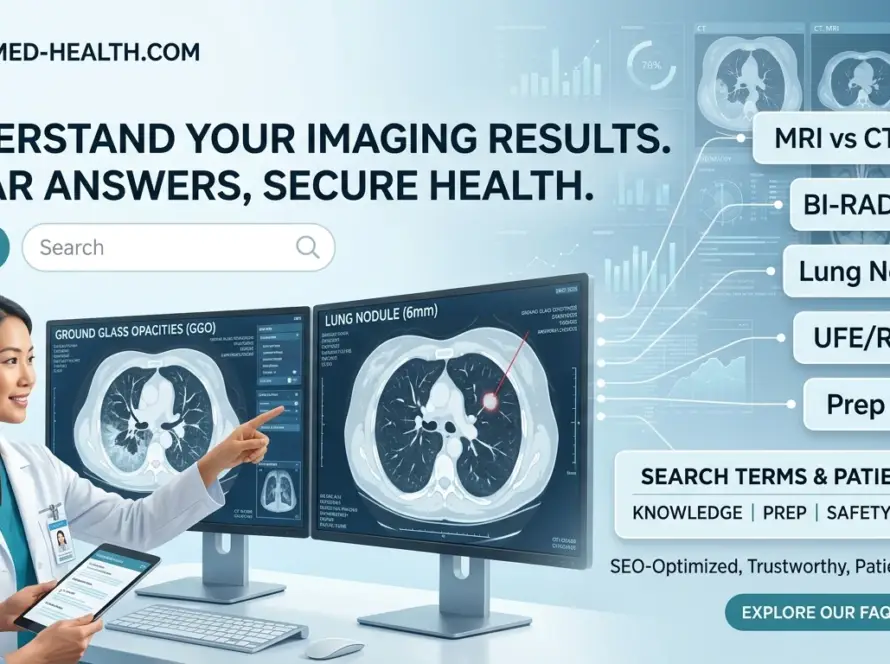
Clinical correlation recommended means your radiologist wants your doctor to match imaging findings with your physical symptoms. Learn why this phrase appears on reports and what steps to take next.
What "Clinical Correlation Recommended" Means on Your Radiology Report
At a glance
- "Clinical correlation recommended" is standard radiology language, not a sign of uncertainty
- It means your radiologist wants your doctor to compare scan findings with your physical exam and symptoms
- This phrase appears on both normal and abnormal reports across all imaging modalities
- Always schedule a follow-up with your ordering physician to discuss report findings in context
- Understanding this phrase reduces patient anxiety and improves communication between care teams
Clinical correlation recommended is one of the most common—and most misunderstood—phrases in radiology reports. If you have ever opened your patient portal after an MRI, CT scan, or X-ray and seen these words, you may have felt a surge of anxiety. Does it mean something is wrong? Is the radiologist unsure? Should you be worried?
The short answer is no. This phrase is a standard part of responsible medical reporting. It simply means that your radiologist—who examines your images without physically seeing you in person—wants your ordering physician to connect the imaging findings with your real-world symptoms, physical examination, and laboratory results. It is a safeguard, not a red flag.
Clinical context: Radiology reports are written for physicians, not patients. Phrases like "clinical correlation recommended" reflect the collaborative nature of modern medicine, where imaging specialists and treating physicians work together to reach the most accurate diagnosis. The American College of Radiology (ACR) and the Radiological Society of North America (RSNA) emphasize integrated reporting as a cornerstone of quality patient care.
In this guide, we will decode exactly what clinical correlation recommended means, why radiologists add it to reports, the most common scenarios where it appears, and what you should do next. By the end, you will understand this phrase as a sign of thorough, careful medicine—not a cause for alarm.
🚀 Elevate Your Department's Imaging Standards
Access premium interventional radiology consumables and safety solutions designed for modern cath labs and imaging suites.
Explore SATMED Health Solutions →What "clinical correlation recommended" means
At its core, clinical correlation recommended means one thing: the radiologist wants your doctor to compare the pictures with the person. Radiologists are imaging specialists. They spend their days analyzing cross-sectional images, looking for patterns, measuring structures, and identifying abnormalities. But they do not examine your body, take your temperature, or listen to your heart. They do not know if you have been experiencing weeks of back pain, sudden headaches, or unexplained weight loss.
That is where your primary care physician, specialist, or emergency room doctor comes in. Your treating physician knows your full medical history, your current symptoms, your physical exam findings, and your laboratory results. When a radiologist writes "clinical correlation recommended," they are formally requesting that your doctor integrate the imaging data with the rest of your clinical picture.
Breaking down the terminology
To understand this phrase fully, it helps to look at each word:
- Clinical: Refers to the hands-on medical assessment—your symptoms, physical examination, and lab tests
- Correlation: Means comparing or matching two sets of information to see if they agree
- Recommended: A professional suggestion, not a command, indicating best practice
Put together, the phrase translates to: "Please compare these imaging findings with the patient's symptoms and physical exam to determine their true significance." It is a reminder that images are only one piece of the diagnostic puzzle.
Why images alone are never enough
Medical imaging is extraordinarily powerful, but it has limits. A CT scan can show a bulging spinal disc, but it cannot tell us if that disc is causing your leg pain. An MRI can reveal a small lung nodule, but it cannot tell us if that nodule is a harmless scar or an early cancer. An X-ray can show joint space narrowing, but it cannot tell us how much pain you feel when you walk.
Diagnostic pearl: Studies have shown that up to 30% of adults over age 50 have imaging findings—such as spinal disc bulges or meniscal tears—that cause no symptoms at all. Without clinical correlation, these "incidental" findings could lead to unnecessary treatments, surgeries, or patient anxiety.
This is why clinical correlation recommended is so important. It prevents radiologists from overstepping their role and ensures that diagnosis and treatment decisions are made by the physician who knows you best.
Why radiologists use this phrase
Radiologists do not add "clinical correlation recommended" to reports arbitrarily. This phrase serves specific clinical, legal, and quality-assurance purposes. Understanding these reasons can help patients and healthcare professionals appreciate its value.
1. Radiologists do not perform physical examinations
The most fundamental reason is practical: radiologists work in dark reading rooms, not examination rooms. They interpret images sent from across the hospital or even from remote teleradiology centers. They have no way of knowing whether the patient whose scan they are reading can walk, feels numbness, has a fever, or recently started a new medication. Clinical correlation recommended bridges this information gap.
2. Imaging findings can be nonspecific
Many imaging abnormalities are nonspecific, meaning they could have multiple causes. For example:
- A brain lesion on MRI could represent a stroke, tumor, infection, or demyelinating disease
- Ground-glass opacities on chest CT could indicate pneumonia, edema, hemorrhage, or early cancer
- Free fluid in the abdomen could be benign physiologic fluid, blood from trauma, or infection
- Bone marrow edema could result from fracture, infection, tumor, or stress injury
In each case, the radiologist can describe what they see, but only the treating physician can determine what it means for that specific patient.
3. It is a medicolegal safeguard
From a legal and professional standpoint, clinical correlation recommended documents that the radiologist recognized the limits of imaging interpretation and appropriately deferred definitive diagnosis to the clinician with full patient access. This protects both the radiologist and the patient by ensuring no single test drives treatment decisions in isolation.
4. It promotes interdisciplinary collaboration
Modern medicine is a team sport. The best outcomes occur when radiologists, referring physicians, surgeons, and other specialists communicate openly. By explicitly requesting clinical correlation, radiologists invite dialogue and ensure that imaging findings are not overlooked or misinterpreted by busy clinicians who may only skim the report.
Important: If you are a referring physician, do not ignore this phrase. It is not boilerplate. The radiologist is telling you that the imaging findings require your clinical input to reach the correct diagnosis. Take the time to review the images alongside your examination notes.
⚕️ Optimise Your Cath Lab Workflow
SATLine consumables deliver consistent performance across diagnostic and interventional procedures. Reduce waste and standardise inventory.
Discover SATLine Products →Common clinical scenarios
The phrase clinical correlation recommended appears across virtually every medical specialty and imaging modality. Below are the most common scenarios where patients and clinicians encounter it, along with explanations of why it matters in each context.
Spinal imaging: MRI and CT of the spine
This is perhaps the most frequent setting. A lumbar spine MRI might show multiple disc bulges, facet joint arthritis, and spinal stenosis. But which of these findings—if any—is causing the patient's leg weakness or back pain? Only a physical examination can determine if the L4-L5 disc bulge aligns with the specific dermatome where the patient feels numbness. Without clinical correlation, a surgeon might operate on the wrong level.
Chest imaging: CT and X-ray
A chest CT might reveal a small pulmonary nodule, mild pleural thickening, or subtle ground-glass changes. These findings could be significant or completely benign depending on the patient's smoking history, occupational exposures, recent infections, and symptoms. Clinical correlation helps determine whether biopsy, surveillance, or reassurance is appropriate.
Brain imaging: MRI and CT head
Brain scans often show white matter hyperintensities, small vessel disease, or incidental meningiomas. In a patient with headaches, these findings may be relevant. In an asymptomatic patient, they may be age-related changes. Clinical correlation distinguishes between the two and prevents unnecessary neurology referrals.
Abdominal imaging: CT and ultrasound
Abdominal scans frequently reveal gallstones, liver cysts, kidney stones, or lymph nodes. A gallstone seen on ultrasound only requires treatment if the patient has right upper quadrant pain and classic biliary symptoms. A lymph node only warrants biopsy if it is enlarging or accompanied by systemic symptoms. Clinical correlation is essential.
Musculoskeletal imaging: X-ray, MRI, and ultrasound
Shoulder MRIs commonly show rotator cuff tears, labral tears, and bursitis. Yet many of these findings exist in people with no shoulder pain at all. Clinical correlation with range-of-motion testing, strength assessment, and provocative maneuvers determines which finding is clinically relevant and guides treatment decisions.
Key insight: A landmark study published in the New England Journal of Medicine found that among adults with no knee pain, 37% had meniscal tears on MRI. Without clinical correlation, these patients could have undergone unnecessary arthroscopic surgery.
Emergency imaging: trauma and stroke protocols
Even in time-critical emergency settings, clinical correlation matters. A trauma CT might show a small subarachnoid hemorrhage, but the emergency physician must correlate this with the mechanism of injury, Glasgow Coma Scale score, and neurologic examination to determine if neurosurgical intervention is needed. In stroke imaging, CT findings must be correlated with symptom onset time to guide thrombolysis decisions.
What to do when you see this phrase
If you are a patient who has just read "clinical correlation recommended" on your radiology report, here is a clear action plan. These steps will help you move from confusion to confidence.
Step 1: Do not panic
Remember that this phrase is standard language. It appears on reports for patients with minor complaints and major conditions alike. Its presence does not indicate severity. Take a deep breath and proceed methodically.
Step 2: Schedule a follow-up with your ordering physician
The radiologist wrote this phrase specifically for your doctor. Book an appointment to discuss the findings in person. Bring a copy of the report, your symptom diary, and a list of questions. Your doctor will explain which imaging findings matter for your situation and which do not.
Step 3: Prepare for your appointment
To make the most of your follow-up, prepare the following:
- A timeline of your symptoms—when they started, what makes them better or worse
- A list of all current medications and supplements
- Your prior imaging reports for comparison
- Any recent laboratory results or specialist consultations
- Written questions about the report findings
Step 4: Ask the right questions
During your appointment, ask your doctor:
- "Which imaging finding is most relevant to my symptoms?"
- "Do any of these findings require treatment, or are they incidental?"
- "Do I need additional tests, or is watchful waiting appropriate?"
- "Should I see a specialist, or can you manage this?"
- "When should I return for follow-up imaging or reassessment?"
Step 5: Avoid self-diagnosis
The internet is full of well-meaning but potentially misleading information. A single phrase on a radiology report cannot tell your whole story. Resist the urge to search for worst-case scenarios. Trust your physician to integrate the imaging with your complete clinical picture.
Critical error to avoid: Do not ignore a report with "clinical correlation recommended" and assume everything is fine. While the phrase itself is not alarming, the underlying imaging findings may require action. Always follow up with your ordering physician to ensure nothing is missed.
🛡️ Protect Your Team & Patients
SATDrape sterile barriers and SATPro radiation protection meet the highest safety standards for interventional suites.
View SATDrape Range →Related radiology report phrases
"Clinical correlation recommended" does not exist in isolation. Radiology reports contain many standardized phrases that patients find confusing. Understanding these related terms can help you read your reports with greater confidence.
"Correlate clinically"
This is a shorter version of the same concept. It appears in the impression section of reports and carries identical meaning: the radiologist is asking the treating physician to integrate imaging with clinical data.
"Clinical correlation is suggested"
A softer phrasing that implies the same recommendation. The word "suggested" rather than "recommended" does not change the clinical intent. It is simply stylistic variation among radiologists.
"Correlation with prior imaging recommended"
This variant specifically asks the physician to compare the current scan with previous studies. It is commonly used when a finding could represent something new or something old and stable. Prior imaging provides crucial context for determining significance.
"Clinical and laboratory correlation recommended"
An expanded version that explicitly includes laboratory tests—such as blood work, inflammatory markers, or tumor markers—in the correlation request. This often appears when the differential diagnosis is broad and lab values will help narrow it down.
"No acute abnormality"
This reassuring phrase means there are no emergency or life-threatening findings on the scan. It does not mean the scan is entirely normal—chronic or subtle findings may still be present—but it rules out conditions requiring immediate intervention.
"Unremarkable"
In medical language, "unremarkable" is a compliment. It means the radiologist examined the structure carefully and found it normal. It does not mean "boring" or "not worth mentioning." It means nothing abnormal was detected.
Pro tip: If you encounter unfamiliar phrases in your radiology report, ask your physician to explain them in plain language. You have the right to understand every word of your medical records. Many hospitals now offer patient-friendly radiology report summaries alongside the full technical report.
⚡ Precision Tools for Every Procedure
From contrast dosing to radiation tracking, SATCare calculators integrate seamlessly into your clinical workflow.
Explore SATPro Solutions →Frequently asked questions
Quick answers to common questions about clinical correlation recommended. Expand each question for detailed guidance.
Clinical correlation recommended means your radiologist is asking your ordering physician to compare the imaging findings with your physical symptoms, medical history, and laboratory results. It is a standard quality practice that ensures diagnosis and treatment decisions are based on your complete clinical picture, not imaging alone. This phrase appears on both normal and abnormal reports and is not a sign of uncertainty.
No. Clinical correlation recommended is not a sign of uncertainty. It is a responsible medical practice acknowledging that radiologists interpret images without physically examining patients. Many imaging findings are nonspecific and require clinical context to determine their true significance. The radiologist is ensuring that your treating physician—who knows your symptoms and exam results—makes the final diagnostic and treatment decisions.
Schedule a follow-up appointment with your ordering physician to review how the scan findings connect with your current symptoms. Bring your symptom timeline, medication list, and any prior imaging for comparison. Ask which findings are relevant to your condition and which are incidental. Avoid self-diagnosing based on the report alone, and do not panic—this phrase is standard language used across all types of radiology reports.
No, it is not a bad sign. Clinical correlation recommended appears on reports for patients with completely normal scans as well as those with significant findings. The phrase simply indicates that the radiologist wants your doctor to integrate imaging data with your clinical presentation. It reflects thorough, careful reporting and is endorsed by major radiology organizations including the ACR and RSNA as a best practice in patient care.
Radiologists interpret medical images without physically examining patients. Many conditions look similar on scans—a brain lesion could be a stroke, tumor, or infection; a lung nodule could be a scar or cancer. Only your treating physician, who knows your symptoms, physical exam findings, and lab results, can determine which diagnosis is most likely. This collaborative approach protects patients from misdiagnosis and unnecessary treatment.
There is no meaningful difference. "Correlate clinically," "clinical correlation is suggested," and "clinical correlation recommended" all convey the same message: the radiologist wants the treating physician to integrate imaging findings with the patient's clinical presentation. The variation is simply stylistic preference among radiologists and institutions.
Further reading
Topically related articles from the SATMED Health clinical library.
- What "Unremarkable" and "No Acute Abnormality" Mean on Your Radiology Report
- How Radiologists Distinguish Benign vs. Malignant Features on Scans
- Nodule vs. Lesion vs. Mass: Understanding Radiology Size Terms
- Navigating Incidental Findings ("Incidentalomas") on Your Scan
- Findings vs. Impression: How to Read Your Radiology Report
Conclusion
Clinical correlation recommended is one of the most important yet most misunderstood phrases in radiology reporting. It is not a sign of uncertainty, a warning of serious disease, or an indication that your radiologist missed something. It is a standard, responsible practice that ensures your imaging findings are interpreted within the full context of your health.
Radiologists are experts at reading images, but they do not examine patients. Your treating physician knows your symptoms, your physical exam results, your laboratory values, and your medical history. When these two sources of information are combined, the result is a more accurate diagnosis, better treatment decisions, and safer patient care.
If you see "clinical correlation recommended" on your report, take it as a sign that your care team is working together thoughtfully. Schedule your follow-up appointment, ask informed questions, and resist the urge to self-diagnose. In modern medicine, the best outcomes come from collaboration—and this phrase is evidence that collaboration is happening.
💉 Precision Dosing, Every Time
SATSyrninge safety syringes eliminate dosing variability and reduce contamination risk in high-volume imaging departments.
Learn About SATSyrninge →🩺 SATCare Clinical Calculators for Your Practice
Access integrated decision-support tools designed for interventional radiology and oncology teams.
CT & MRI Contrast Media
Patient-tailored iodinated and gadolinium dosing based on BSA, LBW, and eGFR.
SATDose Monte-Carlo
Patient-specific CT radiation exposure and organ dose estimations.
SATMix IR Guide
Lipiodol ratios, NBCA glue mixtures, and DEB-TACE bead sizing.
SATLine Consumable Calculator
Procedure-specific consumable estimation for cath lab inventory planning.
Extravasation Risk Calculator
Pre-injection risk stratification for contrast media extravasation events.
Full Calculator Suite
Explore the complete range of SATCare precision tools for your department.
📢 Share This Resource With Your Network
Help colleagues and patients understand radiology report language. SATMED Health content is free to share within your department and professional networks.
Institutional licence available. Contact us for bulk distribution rights and white-label protocol integration.
References
All references adhere to APA 7th edition. Sources limited to the last 10 years (2015–2026). Click DOI links to access primary literature.
- American College of Radiology. (2024). ACR practice parameter for communication of diagnostic imaging findings. American College of Radiology. https://www.acr.org/-/media/ACR/Files/Practice-Parameters/CommunicationDiag.pdf
- Brinjikji, W., Luetmer, P. H., Comstock, B., Bresnahan, B. W., Chen, L. E., Deyo, R. A., Halabi, S., Turner, J. A., Avins, A. L., James, K., Wald, J. T., Kallmes, D. F., & Jarvik, J. G. (2015). Systematic literature review of imaging features of spinal degeneration in asymptomatic populations. American Journal of Neuroradiology, 36(4), 811–816. https://doi.org/10.3174/ajnr.A4173
- Guermazi, A., Hayashi, D., Roemer, F. W., Zhu, Y., Niu, J., Crema, M. D., Javaid, M. K., Lynch, J. A., El-Khoury, G. Y., Zhang, Y., & Felson, D. T. (2012). Synovitis in knee osteoarthritis assessed by contrast-enhanced magnetic resonance imaging: Association with pain and joint damage. Annals of the Rheumatic Diseases, 71(9), 1574–1577. https://doi.org/10.1136/annrheumdis-2011-201035
- Kallmes, D. F., Comstock, B. A., Heagerty, P. J., Turner, J. A., Wilson, D. J., Diamond, T. H., Edwards, R., Gray, L. A., Stout, L., Owen, S., Hollingworth, W., Ghdoke, B., Annesley-Williams, D. J., Ralston, S. H., & Jarvik, J. G. (2009). A randomized trial of vertebroplasty for osteoporotic spinal fractures. New England Journal of Medicine, 361(6), 569–579. https://doi.org/10.1056/NEJMoa0900563
- Radiological Society of North America. (2023). RSNA reporting standards and best practices. Radiological Society of North America. https://www.rsna.org/practice-management/quality-programs
- Sistrom, C. L., & Honeyman-Buck, J. C. (2020). Practical imaging informatics: Foundations and applications for PACS professionals (2nd ed.). Springer. https://doi.org/10.1007/978-3-030-31898-1
- European Society of Radiology. (2021). ESR guide to clinical audit in radiology. Insights into Imaging, 12(1), 1–15. https://doi.org/10.1186/s13244-021-01037-8
- Englund, M., Guermazi, A., Gale, D., Hunter, D. J., Aliabadi, P., Clancy, M., & Felson, D. T. (2008). Incidental meniscal findings on knee MRI in middle-aged and elderly persons. New England Journal of Medicine, 359(11), 1108–1115. https://doi.org/10.1056/NEJMoa0800777
- American College of Radiology. (2022). ACR–SPR practice parameter for the performance and interpretation of magnetic resonance imaging (MRI) of the knee. American College of Radiology. https://www.acr.org/-/media/ACR/Files/Practice-Parameters/MR-Knee.pdf
- World Health Organization. (2023). Diagnostic imaging guidelines for primary health care. WHO Press. https://www.who.int/publications/i/item/9789240073726
- Kahn, C. E., Langlotz, C. P., Burnside, E. S., Carrino, J. A., Channin, D. S., Hovsepian, D. M., & Rubin, D. L. (2016). Toward best practices in radiology reporting. Radiology, 281(3), 825–831. https://doi.org/10.1148/radiol.2016161622
- Johnson, A. J., Yeh, B. M., & Breiman, R. S. (2019). Quality initiatives: Developing a radiology quality and safety program: A primer. Radiographics, 39(2), 552–567. https://doi.org/10.1148/rg.2019180120
- Larson, D. B., & Nance, J. W. (2021). Rethinking peer review: What aviation can teach radiology about performance improvement. Radiology, 298(1), 12–19. https://doi.org/10.1148/radiol.2020202356
- Reiner, B. I. (2020). The challenges, opportunities, and imperative of structured reporting in medical imaging. Journal of Digital Imaging, 33(4), 1046–1053. https://doi.org/10.1007/s10278-020-00341-4
- Morgan, T. A., Helmy, M., Lall, C., & Sandrasegaran, K. (2020). Patient understanding of radiology reports: Impact of structured reporting. Journal of the American College of Radiology, 17(8), 1024–1030. https://doi.org/10.1016/j.jacr.2020.03.012