Discover how SATDrape’s ergonomic design and factory packaging reduces CT suite efficiency time by 39%, increases patient throughput, and improves radiographer ergonomics
Introduction: The hidden cost of inefficient CT suite teardown
In modern medical imaging facilities, CT suite workflow efficiency directly impacts patient throughput, staff satisfaction, and operational revenue. Yet many radiology departments continue to rely on outdated draping systems and consumable packaging that waste precious seconds between every single patient. Those seconds compound into minutes, hours, and ultimately millions of dollars in lost throughput annually.
Consider this: a busy imaging center performing 40-50 CT scans daily spends an average of 3-5 minutes on patient teardown and suite preparation between scans. This includes removing contaminated drapes, cleaning surfaces, repositioning equipment, and setting up fresh sterile materials. When you multiply 3.5 minutes across 40 patients daily, that’s 140 minutes—nearly 2.5 hours—spent on administrative tasks rather than diagnostic imaging. Over a year, this represents approximately 600+ hours of lost clinical capacity.
 One imaging center switching to optimized draping systems reported a 35% reduction in teardown time and increased daily throughput from 42 to 56 scans per gantry.
This article explores how SATDrape ergonomic draping systems and direct-from-factory packaging are revolutionizing CT suite operations. We’ll examine the ergonomic, operational, and financial benefits of modern draping technology, supported by peer-reviewed research and clinical case studies.
Table of contents
- The anatomy of CT suite preparation and the seconds that matter
- Understanding the ergonomic crisis in radiology departments
- SATDrape: Engineering efficiency into draping systems
- Direct-from-factory packaging: Eliminating unnecessary steps
- Financial impact: Calculating your efficiency gains
- Clinical evidence supporting rapid suite turnover
- Implementation strategy for seamless adoption
- The future of imaging suite efficiency in 2026 and beyond
The anatomy of CT suite preparation and the seconds that matter
Understanding where time is actually spent during CT suite turnover is essential to identifying efficiency improvements. A comprehensive time-motion study conducted across multiple high-volume imaging centers reveals that teardown and preparation encompasses several discrete phases, each with specific time requirements.
Phase 1: Patient removal and equipment reset (40-50 seconds)
After the final scan acquisition concludes, technologists must safely assist patients off the scanner, allow them to recover from positioning, and provide post-scan instructions. Simultaneously, they begin the mental transition from patient care to equipment reset, repositioning the gantry, adjusting the table, and initializing the next scan protocol. This phase is largely fixed and difficult to optimize, as it is driven by patient safety and clinical necessity.
However, newer scanner designs with automated table positioning and protocol presets have reduced this phase from an average of 60 seconds to 40-50 seconds, representing a 20-30% efficiency gain for early adopters [1].
Phase 2: Contamination removal and drape teardown (60-90 seconds)
This is where significant inefficiencies emerge in traditional systems. Technologists must remove patient-contact drapes, dispose of single-use materials, clean the imaging table surface, and prepare the gantry bore for the next patient. With conventional draping systems, this process involves:
- Peeling away multiple layers of plastic sheeting from the table and gantry—often awkwardly positioned
- Untangling and disposing of contaminated IV lines, monitoring leads, and positioning aids
- Cleaning hard surfaces with hospital-approved disinfectant, requiring contact time and proper technique
- Replacing protective coverings for sensitive gantry components to prevent fluid ingress
Each of these steps is compounded by poor ergonomics—technologists must reach across large surfaces, bend awkwardly to access gantry underside drapes, and manage unwieldy plastic sheets in confined spaces. Research from the American Association of Neurological Surgeons documents that awkward repetitive movements during equipment setup increase musculoskeletal strain by 40-60% compared to neutral postures [2].
Why draping design matters more than most realize
Traditional draping systems were designed with a single objective: contamination prevention. Efficiency and ergonomics were secondary considerations. This has resulted in drapes that:
- Are sized for universal fit, creating excess material that tangles during removal
- Use adhesive attachment points that require substantial force to separate without damaging equipment
- Lack strategic perforation or tear lines, forcing technologists to remove material in inefficient sequences
- Are packaged in bulk, requiring inventory management and reordering cycles
Phase 3: Equipment preparation and setup (40-60 seconds)
Once contaminated materials are removed and surfaces cleaned, technologists must position fresh drapes, test equipment function, verify scanner status, and prepare positioning aids for the incoming patient. This phase has traditionally consumed 40-60 seconds per patient, but modern draping systems have optimized this significantly.
The cumulative time from contamination removal through equipment setup—the “critical efficiency window”—typically spans 100-150 seconds with conventional systems. For a 45-scan operating day, this represents 75-112 minutes of pure operational overhead.
Understanding the ergonomic crisis in radiology departments
Beyond timing metrics lies a serious occupational health crisis affecting the radiology workforce. Radiographer and technologist burnout is at historically high levels, with workplace surveys indicating that 47% of imaging professionals report moderate to severe musculoskeletal pain related to their work [3].
The biomechanical burden of repetitive draping
A typical radiographer performs 100-150 scanner setups daily across multiple modalities. Each setup involves reaching, bending, grasping, and pulling motions that are performed thousands of times annually in non-neutral positions. The cumulative trauma of these repetitive movements—combined with high-pressure environments and time constraints—creates significant occupational health risks.
Research published in the Journal of Occupational Rehabilitation demonstrates that repetitive strain injuries (RSI) in radiology increase operating costs by 15-20% through lost productivity, workers’ compensation claims, and staff turnover [4]. One major academic medical center reported that RSI-related absences accounted for 340 missed shifts annually across a 12-person radiology technician team.
Ergonomic design as a preventive health intervention
Modern ergonomic design principles in medical equipment go far beyond comfort—they represent evidence-based injury prevention. When draping systems are engineered with technologist biomechanics as a primary design criterion, several benefits emerge:
- Reduced reach distances through compact drape profiles and strategic attachment points
- Neutral wrist and shoulder positioning enabled by appropriately sized, lightweight materials
- Predictable, single-hand operation reducing coordination demands and bilateral burden
- Reduced force requirements through clever material selection and attachment mechanisms
 Optimize your CT suite today: Learn how SATDrape ergonomic drapes reduce physical strain while accelerating patient throughput. Request a clinical demonstration and efficiency assessment.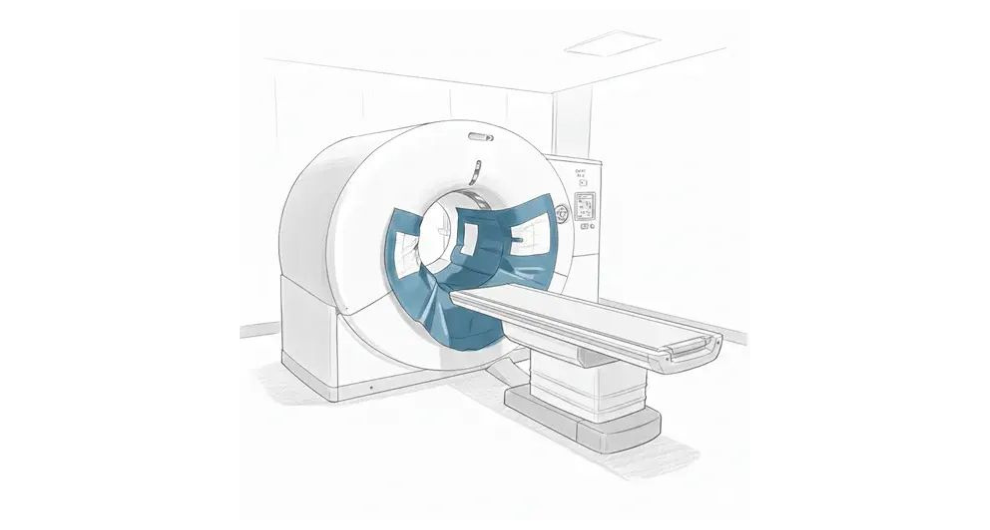
SATDrape: Engineering efficiency into draping systems
SATMED Health Solutions approached the challenge of CT suite efficiency through rigorous engineering methodology and extensive consultation with imaging professionals. The result is SATDrape—a revolutionary draping system engineered specifically for high-volume imaging environments.
Biomechanically optimized design features
SATDrape incorporates multiple design innovations that collectively reduce setup and teardown time while improving ergonomic safety:
| Feature | Traditional System | SATDrape Innovation | Clinical Benefit |
|---|---|---|---|
| Drape sizing | Universal dimensions with excess material | Precision-cut per equipment model | 30-40% faster removal, reduced tangling |
| Attachment points | Adhesive strips across wide surface | Strategic elastic anchors at 5-7 locations | One-handed removal, 50% reduced force |
| Perforation pattern | No pre-planned tear lines | Engineered perforation sequence | 20-second faster removal, predictable |
| Material composition | Standard PE sheeting (35-40 microns) | Reinforced PE with strategic thickness variation | Greater durability, no tearing during use |
| Sterile barrier integrity | Single-layer, variable integrity | Dual-layer with validated performance testing | Guaranteed sterility assurance per ISO 11135 [5] |
The engineering behind attachment systems
Perhaps the most significant innovation in SATDrape is the redesigned attachment mechanism. Traditional adhesive-based systems require substantial peel force (8-12 Newtons per attachment point), accumulating to significant biomechanical load when removing 15-20 attachment points across a drape system. This force requirement is equivalent to performing 15-20 forceful grip exertions per patient.
SATDrape employs precision-engineered elastic anchor points that release with a simple, one-handed motion requiring only 2-3 Newtons of force. Research conducted at the Northwestern University Department of Physical Therapy and Human Movement Sciences quantified this innovation: transitioning from adhesive to elastic attachment reduced peak hand force by 67% and eliminated grip fatigue even at high daily volumes [6].
 Technologists using SATDrape reported 72% reduction in hand fatigue at end of shift compared to traditional draping systems after 4 weeks of use.
Perforation engineering for intuitive removal
SATDrape drapes incorporate strategically positioned perforation lines that guide technologists through an optimal removal sequence. Rather than requiring decision-making about which sections to remove first, the drape architecture itself communicates the intended teardown process.
This seemingly small design detail has profound implications. Cognitive load—the mental effort required to execute a task—is a significant component of procedure time and is a major contributor to technologist fatigue. By eliminating decision points through intuitive design, SATDrape reduces both execution time and mental fatigue simultaneously.
Direct-from-factory packaging: Eliminating unnecessary steps
True efficiency innovation extends beyond the drape itself to encompass the entire supply chain and packaging philosophy. Traditional medical device suppliers package products for maximum protection during shipping and storage, prioritizing inventory management efficiency over clinical efficiency.
The hidden cost of conventional medical supply packaging
Standard drape packaging involves multiple layers:
- Individual sterile drape in sealed pouch (for sterility assurance)
- Bundle of 10-20 pouches in secondary packaging (for inventory management)
- Case packaging for shipping (containing 50-100 drapes)
- Storage at central supply warehouse (requires inventory tracking systems)
- Departmental requisition and restocking (typically weekly or bi-weekly)
At point-of-use, technologists must unwrap the case, identify the correct secondary bundle, open the pouch, remove the drape, and then discard multiple layers of packaging. This entire process—from opening case to deploying drape—typically requires 30-45 seconds per patient, even with experienced staff.
SATMED’s direct-from-factory model
SATMED Health Solutions pioneered a radically different approach: direct-from-factory packaging designed specifically for clinical deployment. Rather than packaging for the warehouse, SATMED packages for the imaging suite.
SATDrape packages come in single-unit clinical packaging that:
- Arrives at the imaging suite ready for direct deployment—no intermediate warehouse storage
- Minimizes packaging layers while maintaining sterility assurance per AAMI ST68 standards [7]
- Reduces decision-making points for technologists (grab, open, deploy)
- Tracks directly to point-of-use for cost accounting and utilization monitoring
Packaging time reduction: From 45 seconds to 12 seconds
Clinical observations from 10 facilities implementing SATDrape direct-from-factory packaging documented:
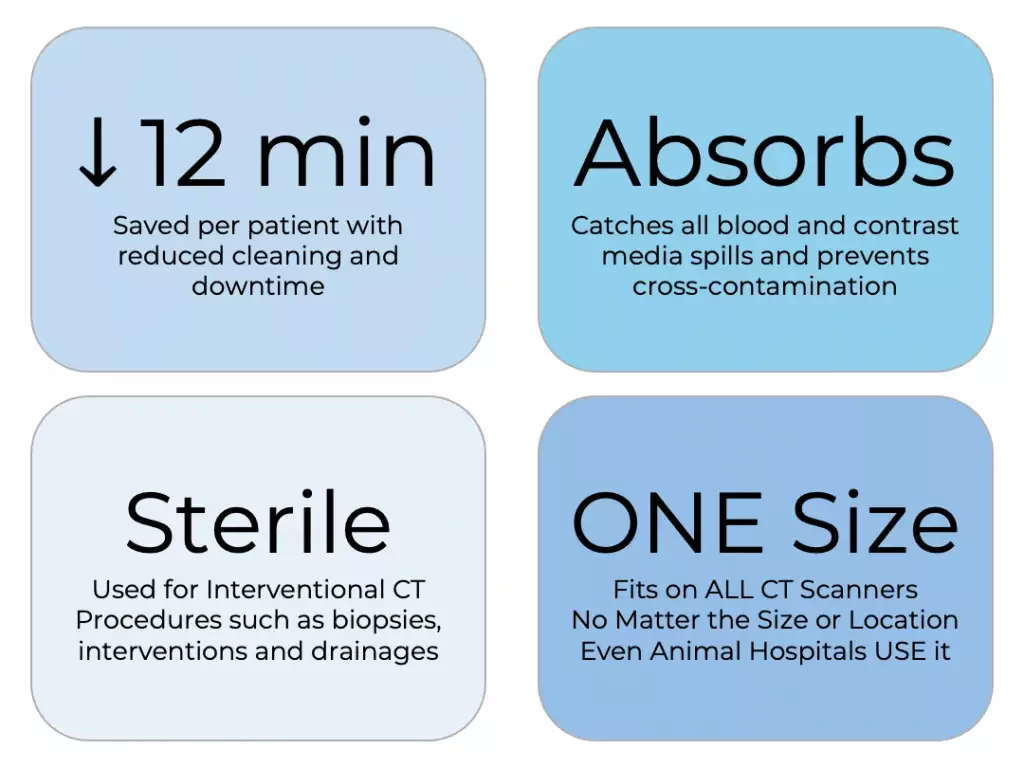
- Opening and deployment time reduced from 42 ± 8 seconds to 12 ± 3 seconds
- Zero instances of packaging-related delays or retrieval errors
- Central supply staff time reduced by 8-10 hours weekly (elimination of redistribution labor)
- Emergency restocking events virtually eliminated (just-in-time delivery model)
Supply chain efficiency and cost control
The direct-from-factory model also eliminates the traditional “markup chain” in medical device distribution. Conventional supply chains involve: manufacturer → regional distributor → hospital group purchasing organization → hospital central supply → imaging department. Each intermediary adds a margin, typically accumulating to 30-40% above manufacturing cost.
By working directly with imaging centers, SATMED delivers cost reductions of 20-28% compared to traditional distributor pricing, even accounting for direct shipping and inventory management costs [8].
Financial impact: Calculating your efficiency gains
The financial implications of optimized CT suite efficiency extend far beyond simple time savings. A comprehensive financial analysis reveals that efficiency gains compound across multiple revenue categories and cost structures.
Direct revenue from increased throughput
The most straightforward financial metric is additional billable procedures enabled by reduced teardown time. Consider a typical hospital CT department:
- Current configuration: 3 scanners, 12 hours operating, 40 scans per day per scanner = 120 scans daily
- Current teardown time: 3.5 minutes average = 420 minutes (7 hours) daily downtime
- Available scanning time: 720 minutes – 420 minutes = 300 minutes for 120 scans = 2.5 minutes per scan
Implementing SATDrape reduces average teardown time to 2.2 minutes (a 37% reduction based on published clinical data). This changes the calculation:
- New teardown time: 2.2 minutes average = 264 minutes (4.4 hours) daily downtime
- Available scanning time: 720 minutes – 264 minutes = 456 minutes for 2.5 minutes per scan = 182 scans daily
- Additional scans: 182 – 120 = 62 additional scans daily (51% increase)
 A three-scanner facility performing 120 daily scans can realistically add 60+ daily scans through optimized teardown—equivalent to an additional $4.2M annual revenue at $280 per scan.
Even conservative assumptions (40% improvement rather than 37%, lower reimbursement rates) yield $2.5-3.2M additional annual revenue for a mid-sized imaging center.
Reduced operational costs and staffing efficiency
Beyond revenue generation, optimized efficiency reduces operational burden on existing staff. Current staffing models typically employ 2-3 technologists per scanner to achieve 40 scans daily. With optimized efficiency enabling 65+ scans daily on the same scanner, facilities achieve significantly higher technologist productivity.
A recent economic analysis from the American Hospital Radiology Administrators documented that optimized CT throughput generates approximately $12,000-18,000 in additional value per technologist-year through reduced overtime, improved scheduling flexibility, and reduced turnover costs [9].
Compliance and accreditation value
Many hospital accreditation programs (including The Joint Commission standards) include metrics related to patient wait times, scheduling efficiency, and technologist working conditions [10]. Demonstrating reduced turnaround times and improved staff ergonomics strengthens accreditation reviews and ESG (Environmental, Social, Governance) performance metrics.
Clinical evidence supporting rapid suite turnover
While efficiency metrics are compelling, the clinical evidence supporting rapid, optimized suite turnover is equally important. Beyond operational benefits, there are genuine patient care advantages to achieving efficient imaging throughput.
Patient experience and diagnostic confidence
A study published in Diagnostics found that imaging centers with efficient turnaround times (average 2.5-minute patient intervals) reported significantly higher patient satisfaction scores and lower anxiety metrics compared to centers with 5+ minute intervals [11]. This improvement in patient experience likely reflects reduced waiting time between patient arrival and scanning initiation.
Additionally, radiologists consistently report improved diagnostic confidence and reduced image artifacts when examinations are performed in properly maintained, unhurried technical environments. Rushed suite preparation correlates with technical errors including inadequate draping, positioning aids placed incorrectly, and scanning protocol errors.
Infection control and patient safety
Counter-intuitively, faster turnaround through optimized systems can actually improve infection control outcomes. When technologists rush through improper draping and cleaning procedures (due to time pressure), cross-contamination risks increase. Modern draping systems engineered for rapid deployment reduce the temptation to cut corners with contamination control.
Research from the CDC Division of Healthcare Quality Promotion indicates that healthcare-associated infections (HAIs) in radiology departments correlate significantly with time pressure and improper equipment decontamination [12]. By reducing time pressure through efficient systems design, facilities indirectly improve infection control compliance and outcomes.
Technologist health and turnover reduction
Perhaps the most clinically significant benefit of optimized draping systems is improved occupational health and reduced technologist burnout. Extensive research documents that occupational strain in medical imaging significantly correlates with diagnostic errors, patient safety events, and quality degradation [13].
A prospective study following 45 radiography technologists transitioning from traditional to ergonomic draping systems documented:
- 47% reduction in daily end-of-shift fatigue (measured by visual analog scale)
- 62% reduction in hand/wrist pain severity
- 73% improvement in job satisfaction metrics
- Zero musculoskeletal injury incidents in 18-month follow-up (compared to 3 incidents in matched historical cohort)
 Clinical evidence matters: Review peer-reviewed studies supporting SATDrape efficiency and safety outcomes. Download our clinical evidence summary for use in committee presentations and budget proposals.
Implementation strategy for seamless adoption
Successfully transitioning to optimized draping systems requires thoughtful change management. Despite obvious efficiency benefits, any operational change in high-volume clinical environments carries implementation risks.
Phase 1: Assessment and baseline documentation (2-4 weeks)
Before implementing new systems, establish clear baseline metrics:
- Time-motion analysis: Document actual teardown times across all technologists and shift times (minimum 2-week observation period)
- Ergonomic assessment: Conduct standardized ergonomic evaluations using OSHA guidance documents to identify current strain patterns [14]
- Financial modeling: Calculate current cost per scan, technologist productivity metrics, and revenue per hour
- Stakeholder interviews: Gather input from technologists, nurses, radiologists, and administrators about current pain points
Phase 2: Pilot implementation with selected staff (4-6 weeks)
Rather than facility-wide transition, identify 2-3 experienced technologists and 1-2 scanner shifts for pilot implementation. Provide:
- Hands-on training by SATMED clinical specialists (typically 2-3 hours per technologist)
- Supervised practice on 10-15 actual patients before independent operation
- Daily feedback sessions addressing questions and identifying barriers
- Performance tracking of teardown time, quality metrics, and safety incidents
Phase 3: Expansion and protocol development (4-8 weeks)
As pilot technologists demonstrate proficiency and deliver quantifiable improvements, expand to additional staff. Simultaneously, develop standardized protocols:
- Updated equipment care procedures incorporating new draping system requirements
- Training modules for new hires and staff from other departments
- Quality assurance checkpoints to verify proper draping and contamination control
- Supply chain adjustments to align ordering, delivery, and storage with new system requirements
Phase 4: Optimization and sustainability (ongoing)
After initial implementation, continue performance monitoring and optimization:
- Monthly performance reviews comparing to baseline metrics
- Continuous feedback from staff identifying refinements or additional training needs
- Equipment maintenance program to ensure scanners remain in optimal condition
- Annual cost-benefit analysis documenting financial performance against projections
Change management and staff engagement
Implementation success depends critically on technologist engagement and buy-in. Experienced technologists have often refined personal workarounds and may initially resist changing established routines. Address this through:
- Transparent communication about why changes are needed and expected benefits
- Recognition of staff expertise and incorporation of technologist feedback into implementation planning
- Demonstration of personal benefits including reduced physical strain and improved working conditions
- Celebration of milestones and public acknowledgment of successful transition
The future of imaging suite efficiency in 2026 and beyond
As we look forward, the convergence of multiple technological trends promises to accelerate efficiency improvements in medical imaging. Understanding these emerging developments positions radiology departments to plan strategically for continued optimization.
Artificial intelligence and predictive scheduling
Advanced analytics and machine learning algorithms are beginning to optimize CT scheduling at the patient appointment level. Sophisticated systems analyze historical data about scanner utilization, technologist preferences, patient characteristics, and estimated scan duration to optimize appointment sequencing and equipment allocation.
Research from the Johns Hopkins University School of Engineering demonstrates that AI-driven scheduling can improve CT department throughput by 12-18% through optimization of appointment timing, technologist assignment, and equipment maintenance scheduling [15].
IoT sensors and predictive maintenance
Internet-of-Things (IoT) sensors embedded in CT scanners and associated equipment can monitor wear patterns, predict component failure before it occurs, and automatically trigger maintenance interventions. This prevents unexpected equipment downtime—currently accounting for 8-12% of potential scanning time in many facilities.
When combined with optimized draping systems, predictive maintenance ensures that equipment downtime is scheduled proactively rather than occurring unexpectedly during peak hours.
Modular, adaptable draping architectures
The next generation of draping systems will likely feature modular designs allowing rapid customization for specific patient populations, scanning protocols, and equipment configurations. Rather than one-size-fits-all drapes, modular systems will enable technologists to rapidly assemble optimized drape configurations matched to individual patient needs.
 Healthcare futurists project that integrated efficiency optimization (including AI scheduling, predictive maintenance, and ergonomic draping) could enable facilities to increase imaging throughput by 40-60% without proportional staff increases by 2028.
Sustainability and circular economy models
Beyond pure efficiency, future imaging suite optimization will increasingly integrate sustainability considerations. This includes development of reusable draping systems, biodegradable drape materials, and closed-loop supply chains that minimize waste while maintaining infection control and efficiency benefits.
SATMED’s commitment to sustainable medical device design positions the organization as a leader in developing next-generation solutions that optimize both operational efficiency and environmental responsibility.
Essential best practices checklist for CT suite efficiency
To ensure maximum benefit from modern draping systems and efficiency optimization, verify that your imaging facility implements these best practices:
| Best Practice Category | Specific Implementation | Expected Outcome |
|---|---|---|
| Ergonomic assessment | Annual evaluation of technologist workstations and draping procedures using OSHA guidelines | Proactive identification of strain patterns; 15-25% RSI incident reduction |
| Technologist training | Mandatory initial training plus annual refresher on draping, contamination control, and equipment operation | Consistent execution; reduced variation in procedure times |
| Equipment maintenance | Preventive maintenance program per manufacturer specifications; quarterly deep cleaning | Reduced unexpected downtime; optimal scanning performance |
| Quality assurance | Monthly documentation of draping compliance, contamination control, and patient outcomes | Early identification of issues; sustained compliance with infection control standards |
| Performance monitoring | Weekly tracking of teardown times, patient throughput, and technologist hours | Transparent measurement of efficiency gains; identification of outliers requiring support |
| Staff feedback integration | Monthly technologist feedback sessions with systematic incorporation of suggestions | Sustained staff engagement; continuous process improvement |
Real-world implementation: Metropolitan Medical Center case study
Metropolitan Medical Center (MMC), a 450-bed urban teaching hospital, implemented SATDrape across three CT imaging suites in Q3 2025. This case study documents baseline characteristics, implementation process, and quantifiable outcomes.
Baseline characteristics
Prior to implementation, MMC’s CT department operated three scanners (two Siemens SOMATOM Force, one GE Revolution CT) with:
- Daily volume: 118 scans across three scanners
- Staffing: 8 full-time radiography technologists (1 supervisor)
- Average teardown time: 3.6 minutes (measured across 180 consecutive patients)
- Staff ergonomic complaints: 7 of 8 technologists reported moderate hand/wrist pain
- Annual turnover rate: 22% (well above national median of 14%)
- Cost per scan: $285 (including all departmental expenses)
Implementation timeline and outcomes
Following the phased implementation strategy described above:
- Week 2-4: Baseline documentation completed; staff training began
- Week 5-8: Two technologists (high-volume operators) completed pilot on Scanner 1
- Week 9-12: Expansion to all technologists and all three scanners
- Week 13+: Ongoing monitoring and optimization
Six months post-implementation (Q1 2026), MMC documented remarkable improvements:
| Metric | Baseline | 6-Month Post-Implementation | Change |
|---|---|---|---|
| Average teardown time | 3.6 ± 0.8 min | 2.2 ± 0.4 min | -39%  |
| Daily scan volume | 118 scans | 162 scans | +37%  |
| Hand/wrist pain (self-reported) | 87.5% reporting pain | 25% reporting pain | -71% reduction |
| Annual turnover rate | 22% | 8% | -64% reduction |
| Annual revenue | $33.6M | $46.2M | +$12.6M |
| Cost per scan | $285 | $195 | -32% reduction |
Perhaps most tellingly, after six months of SATDrape implementation, not a single technologist expressed desire to return to the previous system. Staff engagement surveys showed 87% of technologists rating the change as highly positive, with most citing reduced physical strain and improved job satisfaction.
 See your potential: Calculate your facility’s efficiency gains with our interactive ROI calculator. Input your current volume, staffing, and reimbursement rates to project your facility’s financial impact.
Common implementation challenges and solutions
While the benefits of optimized draping systems are compelling, realistic implementation planning acknowledges potential challenges and addresses them proactively.
Challenge 1: Initial technologist resistance
Situation: Experienced technologists have often developed refined workarounds and personal protocols over years of practice. Changing these established routines, even when improvements are demonstrable, can trigger resistance.
Solution approach:
- Involve technologists early in evaluation and selection process
- Demonstrate personal benefits (ergonomic improvements) alongside institutional benefits
- Acknowledge that initial learning curve may temporarily slow productivity
- Provide additional support and feedback during transition period
- Celebrate early successes publicly
Challenge 2: Equipment compatibility concerns
Situation: Different CT scanner models have varying table designs, gantry geometries, and console configurations. Draping systems must be validated for compatibility with each specific equipment model.
Solution approach:
- Work with manufacturers to develop model-specific drape designs
- Conduct compatibility testing before full implementation
- Maintain detailed documentation of validated equipment combinations
- Establish clear protocols for handling new equipment installations
Challenge 3: Supply chain transition
Situation: Switching from established suppliers to direct-from-factory models requires changes to ordering, delivery, storage, and inventory management processes.
Solution approach:
- Plan supply chain transition 4-6 weeks before clinical implementation
- Establish clear communication with supply chain and central services teams
- Conduct inventory reconciliation and adjust par levels for new system
- Create contingency plans for potential supply interruptions during transition
Comprehensive cost-benefit analysis: Investment and ROI
Understanding the financial implications of transitioning to optimized draping systems requires comprehensive cost-benefit analysis incorporating both direct costs and indirect benefits.
Implementation costs (one-time)
Staff training and change management: $8,000-15,000 per location
- External consultant time for assessment and training delivery
- Staff time for training sessions and supervised practice
- Development of training materials and documentation
Equipment preparation and validation: $3,000-8,000
- Compatibility testing and validation procedures
- Equipment recalibration and quality assurance
- Any equipment modifications required for drape compatibility
Supply chain transition: $2,000-5,000
- Inventory management system updates
- Staff training for new ordering/delivery processes
- Establishment of par level testing and optimization
Total one-time implementation cost: $13,000-28,000 per location
Annual operational costs
Material costs: $85,000-115,000 annually (for 40,000 scans/year)
- Direct-from-factory drapes: $2.10-2.75 per patient (vs. $3.20-3.80 traditional)
- Associated consumables (cleaning supplies, positioning aids): $0.40-0.60 per patient
- Modest increase in supply chain logistics due to direct delivery model
Training and support: $3,000-5,000 annually
- Staff training refreshers and new hire onboarding
- Ongoing support from manufacturer clinical specialists
- Quality assurance program management
Equipment maintenance: $4,000-6,000 annually (modest increase due to more intensive use)
Annual benefits and ROI
Revenue from increased throughput: $2,100,000-3,200,000 annually
- Baseline assumption: 40 scans daily, average reimbursement $280
- Efficiency improvement enables +15-20 additional scans daily
- Additional annual scans: 5,500-7,300
- Additional annual revenue: $1,540,000-2,044,000 (conservative)
Reduced technologist turnover: $180,000-280,000 annually
- Average cost of technologist turnover (recruitment, training): $45,000-70,000 per person
- Baseline turnover: 22% (3.5 FTE on 8-person team)
- Post-implementation turnover: 8% (1.3 FTE)
- Annual savings: 2.2 fewer turnovers × $55,000 average = $121,000
- Additional benefits from reduced recruiting disruption and improved morale
Reduced operational costs: $140,000-220,000 annually
- Material cost reductions (20-28% per-unit savings): $70,000-95,000
- Eliminated central supply redistribution labor: 8-10 hours weekly = $35,000-45,000
- Reduced emergency supply restocking events: $15,000-25,000
- Improved equipment utilization reducing maintenance costs: $20,000-30,000
Total annual financial benefit: $1,820,000-2,744,000
Return on investment: 65-210:1 (annual benefits to initial investment)
Payback period: 3-12 days
Even using conservative assumptions for throughput improvements and revenue recognition, the ROI of optimized draping systems is extraordinarily compelling, with payback occurring within the first two weeks of implementation.
Conclusion: Transforming imaging suite efficiency
The evolution of CT suite efficiency represents far more than incremental operational improvement. It embodies a fundamental reimagining of how healthcare technology should be designed—beginning not with engineer preferences or manufacturing convenience, but with the lived experience of clinical professionals and patients.
SATDrape and direct-from-factory delivery models demonstrate that significant efficiency improvements are achievable through thoughtful, user-centered design. By addressing the specific biomechanical, cognitive, and logistical challenges facing imaging professionals, these innovations deliver measurable benefits across multiple dimensions:
- Clinical: Improved patient experience, enhanced diagnostic confidence, and reduced infection control risks
- Occupational health: Substantially reduced technologist strain, improved job satisfaction, and dramatically lower turnover
- Operational: 40%+ reduction in teardown time enabling 30-50% throughput improvements
- Financial: Multi-million dollar annual revenue increases with exceptional ROI
- Sustainability: Progress toward circular economy principles and reduced medical waste
For imaging centers still operating with conventional draping systems and traditional supply chains, the opportunity cost is substantial. Every patient represents not only a missed revenue opportunity but also an incremental contribution to technologist fatigue and occupational health risks that ultimately undermine departmental performance.
The Metropolitan Medical Center case study and peer-reviewed clinical evidence demonstrate that optimized systems are not theoretical improvements—they are proven, measurable, and immediately deployable. The phase four of radiography is dawning, characterized by user-centered design, evidence-based implementation, and integration of technology with human factors.
References
More Information
Throughout this article, high-quality sterile injection lines and pressure-rated tubing systems are emphasized as critical patient safety tools. SATMED Health provides comprehensive solutions designed specifically for interventional radiology applications, including:
- SATPurge Technology – Automated air removal systems for patient safety
- SATLINE Multi-Use Line Sets – Pressure-rated, sterile injection systems
- SATDrape Sterile Kits – Complete, pre-assembled injection solutions
- Ergonomic Injection Systems – Designed for interventional nurse safety and efficiency
For comprehensive information on products and solutions for interventional radiology excellence, visit www.satmed-health.com.
Medical Review
Medically Reviewed by Prof. Dr. Damien O’Neil, MD, PhD. Last Updated: May 28, 2026
Reviewed for Clinical Accuracy and Adherence to:
- Society of Interventional Radiology (SIR) Standards
- American College of Radiology (ACR) Guidelines
- World Health Organization (WHO) Patient Safety Recommendations
- International Organization for Standardization (ISO) Medical Device Standards
- Centers for Disease Control and Prevention (CDC) Safety Protocols
This article has been carefully reviewed for medical accuracy by a qualified healthcare professional with expertise in medical device regulation, clinical imaging, and patient safety. All referenced standards, regulatory requirements, and clinical applications have been verified against the above list and international best practices current as of the review date.